Sugarcane is indigenous to tropical South Asia and Southeast Asia.Different species likely originated in different locations with S. barberioriginating in India and S. edule and S. officinarum coming from New Guinea. Crystallized sugar was reported 5,000 years ago in India.
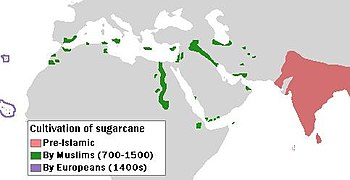
Around the eighth century A.D., Indian traders introduced sugar to the Mediterranean, Mesopotamia, Egypt, North Africa, and Andalusia. By the tenth century, sources state, there was no village in Mesopotamia that did not grow sugar cane. It was among the early crops brought to the Americas by theAndalusians (from their fields in the Canary Islands), and the Portuguese.
 |
The westward diffusion of sugarcane in pre-Islamic
times (shown in red), in the medieval Muslim world
(green) and by Europeans (violet)[2] |
"Boiling houses" in the 17th through 19th centuries converted sugarcane juice into raw
sugar. These houses were attached to sugar plantations in the western colonies. Slaves often ran the boiling process, under very poor conditions. Made of cut stone, rectangular boxes of brick or stone served as furnaces with an opening at the bottom to stoke the fire and remove ashes. At the top of each furnace were up to seven copper kettles or boilers, each one smaller and hotter than the previous one. The cane juice began in the largest kettle. The juice was then heated and lime added to remove impurities. The juice was skimmed, then channeled to successively smaller kettles. The last kettle, which was called the 'teache', was where the cane juice became syrup. The next step was a cooling trough, where the sugar crystals hardened around a sticky core of molasses. This raw sugar was then shoveled from the cooling trough into hogsheads (wooden barrels), and from there into the curing house.
 |
A sugar plantation on the island of
Réunion in the late 1800s |
Sugarcane is still extensively grown in the Caribbean. Christopher Columbus first brought it during his second voyage to the Americas, initially to the island of Hispaniola (modern day Haiti and the Dominican Republic). In colonial times, sugar formed one side of the triangular trade of New World raw materials, European manufactures, and African slaves. France found its sugarcane islands so valuable, it effectively traded its portion of Canada, famously dubbed "a few acres of snow," to Britain for their return of Guadeloupe, Martinique and St. Lucia at the end of the Seven Years' War. The Dutch similarly kept Suriname, a sugar colony in South America, instead of seeking the return of the New Netherlands (New York). Cuban sugarcane produced sugar that received price supports from and a guaranteed market in the USSR; the dissolution of that country forced the closure of most of Cuba's sugar industry. Sugarcane remains an important part of the economy of Guyana, Belize, Barbados, Haiti, along with the Dominican Republic, Guadeloupe, Jamaica, and other islands.
Sugarcane production greatly influenced many tropical
Pacific Islands, including
Okinawa and, most particularly,
Hawaiʻi and
Fiji. In these islands, sugarcane came to dominate the economic and political landscape after the arrival of powerful European and American agricultural businesses, which promoted immigration of workers from various Asian countries to tend and harvest the crop. Sugar was the dominant factor in diversifying the islands' ethnic makeup, profoundly affecting their politics and society.
Brazil is the biggest grower of sugarcane, which goes for sugar and
ethanol for gasoline-ethanol blends (
gasohol) for transportation
fuel. In
India, sugarcane is sold as
jaggery, and also refined into sugar, primarily for consumption in tea and sweets, and for the production of alcoholic beverages.
Cultivation |
| Sugar cane field on Madeira |
Sugarcane cultivation requires a tropical or temperate climate, with a minimum of 60 centimetres (24 in) of annual moisture. It is one of the most efficient photosynthesizers in the plant kingdom. It is a C-4 plant, able to convert up to 2 percent of incident solar energy into biomass. In prime growing regions, such as India, Pakistan, Peru, Brazil, Bolivia, Colombia, Australia, Ecuador, Cuba, the Philippines, El Salvador and Hawaii, sugarcane can produce 20 lb (9 kg) for each square meter exposed to the sun.
Although sugarcanes produce seeds, modern stem cutting has become the most common reproduction method. Each cutting must contain at least one bud and the cuttings are sometimes hand-planted. In more technologically advanced countries like the United States and Australia,billet planting is common. Billets harvested from a mechanical harvester are planted by a machine which opens and recloses the ground. Once planted, a stand can be harvested several times; after each harvest, the cane sends up new stalks, called ratoons. Successive harvests give decreasing yields, eventually justifying replanting. Two to ten harvests may be possible between plantings.Sugarcane is harvested by hand and mechanically. Hand harvesting accounts for more than half of production, and is dominant in the developing world. In hand harvesting the field is first set on fire. The fire burns dry leaves, and kills any lurking venomous snakes, without harming the water-rich stalks and roots. Harvesters then cut the cane just above ground-level using
cane knives or
machetes. A skilled harvester can cut 500 kilograms (1,100 lb) of sugarcane per hour.
 |
Sugarcane mechanical harvest in
Jaboticabal, São Paulo, Brazil |
Mechanical harvesting uses a combine, or chopper harvester. The Austoft 7000 series was the original modern harvester design that has now been copied by other companies including Cameco/ John Deere. The machine cuts the cane at the base of the stalk, strips the leaves, and deposits the cane into a transporter, while blowing the thrash back onto the field. Such machines can harvest 100 long tons (100 t) each hour, but machine-harvested cane must be rapidly processed. Once cut, sugarcane begins to lose its sugar content, and damage to the cane during mechanical harvesting accelerates this decline.
Pests
The cane grub can substantially reduce crop yield by eating roots; it can be controlled with Confidor or Lorsban. Other important pests are the larvae of some butterfly/moth species, including the turnip moth, the sugarcane borer (Diatraea saccharalis), the Mexican rice borer (Eoreuma loftini); leaf-cutting ants, termites, spittlebugs (especially Mahanarva fimbriolata and Deois flavopicta), and the beetle Migdolus fryanus. The planthopper insect Eumetopina flavipes acts as a phytoplasma vector, which causes the sugarcane disease ramu stunt.
Pathogens
Nitrogen fixation
Some sugarcane varieties are known to be capable of fixing atmospheric nitrogen in association with the bacterium Glucoacetobacter diazotrophicus.[5] Unlike legumes and other nitrogen fixing plants which form root nodules in the soil in association with bacteria, G. diazotrophicus lives within the intercellular spaces of the sugarcane's stem.[6][7] Processing  |
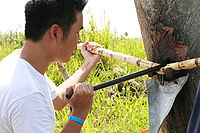
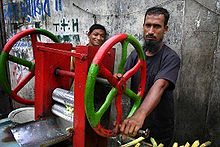
Manually extracting juice from
sugarcane |
Traditionally, sugarcane processing requires two stages. Mills extract raw sugar from freshly harvested cane, and sometimes bleach it to make "mill white" sugar for local consumption. Refineries, often located nearer to consumers in North America, Europe, and Japan, then produce refined white sugar, which is 99 percent sucrose. These two stages are slowly merging. Increasing affluence in the sugar-producing tropics increased demand for refined sugar products, driving a trend toward combined milling and refining.
MillingSmall rail networks are a common method of transporting cane to a mill. Refineries test newly arrived cane for Brix and trash percentage.  |
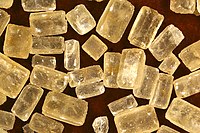
| Sugar crystals |
The mill washes, chops, and uses revolving knives to shred the cane. Shredded cane is repeatedly mixed with water and crushed between rollers; the collected juices contain 10–15 percent sucrose, and the remaining fibrous solids, called bagasse, are burned for fuel. Bagasse makes a sugar mill more than energy self-sufficient; surplus bagasse goes in animal feed, in paper manufacture, or to generate electricity for sale. The cane juice is next mixed with lime to adjust its pH to 7. This mixing arrests sucrose's decay into glucose and fructose, and precipitates some impurities. The mixture then sits, allowing the lime and other suspended solids to settle. The clarified juice is concentrated in a multiple-effect evaporator to make a syrup about 60 percent sucrose by weight. This syrup is further concentrated under vacuum until it becomessupersaturated, and then seeded with crystalline sugar. On cooling, more sugar crystallizes from the syrup. A centrifuge separates the sugar from the molasses. Additional crystallizations extract more sugar; the final residue is called blackstrap.  |
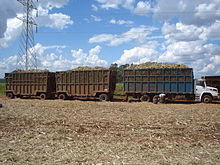
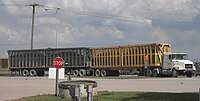
A truck hauls cane to a sugar mill
in Florida |
Raw sugar is yellow to brown. Bubbling sulfur dioxide through the cane juice before evaporation bleaches many color-forming impurities into colorless ones. This sulfitation produces sugar known as "mill white", "plantation white", and "crystal sugar". Such sugar is the most commonly consumed in sugarcane-producing countries.
Refining |
Santa Elisa sugarcane processing
plant in Sertãozinho, one of the largest
and oldest in Brazil |
Sugar refining further purifies the raw sugar. It is first mixed with heavy syrup and then centrifuged in a process called 'affination'. Its purpose is to wash away the sugar crystals' outer coating, which is less pure than the crystal interior. The remaining sugar is then dissolved to make a syrup, about 60 percent solids by weight. |
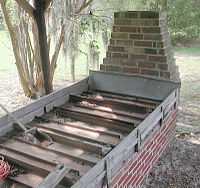
Evaporator with baffled pan and foam
dipper for making ribbon cane syrup |
After filtering any remaining solids, the clarified syrup is decolorized by filtration through activated carbon. Bone char is traditionally used in this role.[8] Some remaining color-forming impurities adsorb to the carbon. The purified syrup is then concentrated to supersaturation and repeatedly crystallized in a vacuum, to produce white refined sugar. As in a sugar mill, the sugar crystals are separated from the molasses by centrifuging. Additional sugar is recovered by blending the remaining syrup with the washings from affination and again crystallizing to produce brown sugar. When no more sugar can be economically recovered, the final molasses still contains 20–30 percent sucrose and 15–25 percent glucose and fructose.To produce granulated sugar, in which individual grains do not clump, sugar must be dried, first by heating in a rotary dryer, and then by blowing cool air through it for several days. Ribbon cane syrup
 |
A centrifuge battery, which separates
the sugar syrup from the
remaining solids |
Ribbon cane is a subtropical type that was once widely grown in the southern United States, as far north as coastal North Carolina. The juice was extracted with horse or mule-powered crushers; the juice was boiled, like maple syrup, in a flat pan, and then used in the syrup form as a food sweetener. It is not currently a commercial crop, but a few growers find ready sales for their product Production
Ethanol is generally available as a by-product of sugar production. It can be used as a biofuel alternative to gasoline, and is widely used in cars in Brazil. It is a promising alternative to gasoline, and may become the primary product of sugarcane processing, rather than sugar. A textbook on renewable energy[11] describes the energy transformation:  |
Worldwide sugarcane production |
At present, 75 tons of raw sugar cane are produced annually per hectare in Brazil. The cane delivered to the processing plant is called burned and cropped (b&c), and represents 77% of the mass of the raw cane. The reason for this reduction is that the stalks are separated from the leaves (which are burned and whose ashes are left in the field as fertilizer), and from the roots that remain in the ground to sprout for the next crop. Average cane production is, therefore, 58 tons of b&c per hectare per year.
Each ton of b&c yields 740 kg of juice (135 kg of sucrose and 605 kg of water) and 260 kg of moist bagasse (130 kg of dry bagasse). Since the higher heating value of sucrose is 16.5 MJ/kg, and that of the bagasse is 19.2 MJ/kg, the total heating value of a ton of b&c is 4.7 GJ of which 2.2 GJ come from the sucrose and 2.5 from the bagasse.
Per hectare per year, the biomass produced corresponds to 0.27 TJ. This is equivalent to 0.86 W per square meter. Assuming an average insolation of 225 W per square meter, the photosynthetic efficiency of sugar cane is 0.38%.
The 135 kg of sucrose found in 1 ton of b&c are transformed into 70 litres of ethanol with a combustion energy of 1.7 GJ. The practical sucrose-ethanol conversion efficiency is, therefore, 76% (compare with the theoretical 97%).
One hectare of sugar cane yields 4,000 litres of ethanol per year (without any additional energy input, because the bagasse produced exceeds the amount needed to distill the final product). This however does not include the energy used in tilling, transportation, and so on. Thus, the solar energy-to-ethanol conversion efficiency is 0.13%.
Sugarcane as foodIn most countries where sugarcane is cultivated, there are several foods and popular dishes derived directly from it, such as:
- Raw sugarcane: chewed to extract the juice
- Sugarcane juice: a combination of fresh juice, extracted by hand or small mills, with a touch of lemon and ice to make a popular drink, known variously as ganne ka rass, guarab, guarapa, guarapo, papelón, aseer asab, Ganna sharbat, mosto and caldo de cana
- Cachaça: the most popular distilled alcoholic beverage in Brazil; a liquor made of the distillation of sugarcane
- Jaggery: a solidified molasses, known as Gur or Gud in India, traditionally produced by evaporating juice to make a thick sludge and then cooling and molding it in buckets. Modern production partially freeze dries the juice to reduce caramelization and lighten its color. It is used as sweetener in cooking traditional entrees, sweets and desserts.
- Panela: solid pieces of sucrose and fructose obtained from the boiling and evaporation of sugarcane juice; a food staple in Colombia and other countries in South and Central America
- Molasses: used as a sweetener and a syrup accompanying other foods, such as cheese or cookies
- Rapadura: a sweet flour which is one of the simplest refinings of sugarcane juice
- Rum: a liquor made of the distillation of sugarcane commonly produced in the Caribbean. Rum is more purified then the Brasilian Cachaça.
- Falernum: a sweet, and lightly alcoholic drink made from sugar cane juice.
- Syrup: a traditional sweetener in soft drinks, now largely supplanted (in the US at least) by high-fructose corn syrup, which is less expensive because of subsidies.
- Rock candy: crystallized cane juice
- Sayur Nganten : name of Indonesian soup made of trubuk stem (Saccharum edule).
References:- ^ a b "Crop production". Food and Agriculture Organization of the United Nations. Retrieved 2010-06-17.
- ^ a b Watson, Andrew. Agricultural innovation in the early Islamic world. Cambridge University Press. p.26–7.
- ^ a b Sharpe, Peter (1998). Sugar Cane: Past and Present. Illinois: Southern Illinois University.
- ^ Eumetopina flavipes and Ramu Stunt
- ^ Yamada, Y., Hoshino, K. & Ishikawa, T. (1998). "Gluconacetobacter corrig. (Gluconoacetobacter [sic]). In Validation of Publication of New Names and New Combinations Previously Effectively Published Outside the IJSB, List no. 64. Int J Syst Bacteriol 48:327–328.
- ^ Z. Dong et al., A Nitrogen-Fixing Endophyte of Sugarcane Stems (A New Role for the Apoplast), Plant Physiology, 1994, Vol 105, Issue 4 1139-1147
- ^ R. M. Boddey, S. Urquiaga, V. Reis and J. Döbereiner, Biological nitrogen fixation associated with sugar cane, Plant and Soil, Volume 137, Number 1 / November, 1991
- ^ Yacoubou, MS, Jeanne (2007). "Is Your Sugar Vegan? An Update on Sugar Processing Practices" (PDF). Vegetarian Journal (Baltimore, MD: The Vegetarian Resource Group) 26 (4): 16–20. Retrieved 2007-04-04.
- ^ "Three largest producing states of important crops". Retrieved 2008-04-06.
- ^ "Meagher: Sugarcane IPM". ipmworld.umn.edu. Retrieved 2008-04-11.
- ^ da Rosa, A, Fundamentals of Renewable Energy Processes, 2005, Elsevier, ISBN 978-0-12-088510-7, pp. 501-502
- Bailey, L. H. and Bailey, E. Z. 1976. Hortus Third: A Concise Dictionary of Plants Cultivated in the United States and Canada. MacMillan Publishing Company, New York
Retrieved from: Wikipedia