


Gelatin: What and How to Make It!
Posted byGelatin
Gelatin (spelled gelatine in some Commonwealth countries, from the French gélatine) is a translucent, colorless, brittle (when dry), nearly tasteless solid substance, derived from the collagen inside animals' skin and bones. It is commonly used as a gelling agent in food,pharmaceuticals, photography, and cosmetic manufacturing. Substances containing gelatin or functioning in a similar way are calledgelatinous. Gelatin is an irreversibly hydrolysed form of collagen, and is classified as a foodstuff, with E number E441. It is found in some gummy candies as well as other products such as marshmallows, gelatin dessert, and some low-fat yogurt. Household gelatin comes in the form of sheets, granules, or powder. Instant types can be added to the food as they are; others need to be soaked in water beforehand. Some dietary or religious customs forbid the use of gelatin from certain animal sources, and medical issues may limit or prevent its consumption by certain people.[1]
Gelatin (spelled gelatine in some Commonwealth countries, from the French gélatine) is a translucent, colorless, brittle (when dry), nearly tasteless solid substance, derived from the collagen inside animals' skin and bones. It is commonly used as a gelling agent in food,pharmaceuticals, photography, and cosmetic manufacturing. Substances containing gelatin or functioning in a similar way are calledgelatinous. Gelatin is an irreversibly hydrolysed form of collagen, and is classified as a foodstuff, with E number E441. It is found in some gummy candies as well as other products such as marshmallows, gelatin dessert, and some low-fat yogurt. Household gelatin comes in the form of sheets, granules, or powder. Instant types can be added to the food as they are; others need to be soaked in water beforehand. Some dietary or religious customs forbid the use of gelatin from certain animal sources, and medical issues may limit or prevent its consumption by certain people.[1]
Gelatin best known as a gelling agent in cooking, different types and grades of gelatin are used in a wide range of food and non-food products: Common examples of foods that contain gelatin are gelatin desserts, trifles, aspic, marshmallows, and confectioneries such as Peeps, gummy bears and jelly babies. Gelatin may be used as a stabilizer, thickener, or texturizer in foods such as jams, yoghurt, cream cheese, and margarine; it is used, as well, in fat-reduced foods to simulate the mouthfeel of fat and to create volume without adding calories. Gelatin is used for the clarification of juices, such as apple juice, and of vinegar. Isinglass, from the swim bladders of fish, is still used as a fining agent for wine and beer. Beside hartshorn jelly, from deer antlers (hence the name "hartshorn"), isinglass was one of the oldest sources of gelatin. Gelatin was used for hardening paper in Colonial times.[1]

Example of Product that Contain Gelatin (Gummy, Jelly, Ice Cream, Marsmallows)
Background
Until the mid-nineteenth century, making gelatin was a laborious task. Calves' feet were loaded into a large kettle that was then placed over a fire. The feet were boiled for several hours after which the liquid was strained and the bones were discarded. After setting for 24 hours, a layer of fat would rise to the top. This was skimmed off and discarded. Sweeteners and or flavorings were added to the liquid and it was poured into molds and allowed again to set.
By the 1840s, however, some producers were grinding the set gelatin into a fine powder or cutting it into sheets. One of them was Charles B. Knox, a salesman from Johnston, New York, who hit on the idea of making gelatin more convenient after watching his wife Rose make it in their kitchen. Knox packaged dried sheets of gelatin and then hired salesmen to travel door-to-door to show women how to add liquid to the sheets and use it to make aspics, molds, and desserts. In 1896, Rose Knox published Dainty Desserts, a book of recipes using Knox gelatin.
The first patent for a gelatin dessert was issued in 1845 to industrialist and inventor Peter Cooper. Cooper had already made a name for himself as the inventor of the Tom Thumb steam engine. He had also made a fortune in the manufacture of glue, a process similar to that for making gelatin.
In 1897, Pearl B. Wait, a carpenter and cough medicine manufacturer, developed a fruit-flavored gelatin. His wife, May Davis Wait, named his product Jell-O. The new product was not immediately popular and Wait sold the rights to the process to Orator Francis Woodward, owner of the Genesee Food Company, for $450. Sales continued to limp along until 1902 when an aggressive advertising campaign in Ladies Home Journal magazine generated enormous interest. Sales jumped to $250,000.
The use of gelatin in food preparation increased six-fold in the 40-year period from 1936-1976. Today, 400 million packages of Jello-O are produced each year. Over a million packages are purchased or eaten each day. In the field of photography, gelatin was introduced in the late 1870s as a substitute for wet collodion. It was used to coat dry photographic plates, marking the beginning of modern photographic methods.
Raw Materials
Animal bones, skins, and tissue are obtained from slaughterhouses. Gelatin processing plants are usually located nearby so that these animal byproducts can be quickly processed. Acids and alkalines such as caustic lime or sodium carbonate are used to extract minerals and bacteria from the animal parts. They are either produced in the food processing plant or purchased from outside vendors. Sweeteners, flavorings, and colorings are added in the preparation of food gelatin. These can be in liquid or powdered forms and are purchased from outside vendors.

The Manufacturing Process
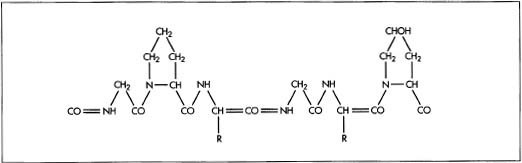
Gelatin Structure
The Manufacturing Process
- Inspection and cutting. When the animal parts arrive at the food processing plant, they are inspected for quality. Rotted parts are discarded. Then, the bones, tissues, and skins are loaded into chopping machines that cut the parts into small pieces of about Sin (12.7cm) in diameter.
- Degreasing and roasting. The animal parts are passed under high-pressure water sprays to wash away debris. They are then degreased by soaking them in hot water to reduce the fat content to about 2%. A conveyer belt moves the degreased bones and skins to an industrial dryer where they are roasted for approximately 30 minutes at about 200° F (100° C).
- Acid and akaline treatment. The animal parts are soaked in vats of lime or some other type of acid or akali for approximately five days. This process removes most of the minerals and bacteria and facilitates the release of collagen. The acid wash is typically a 4% hydrochloric acid with a pH of less than 1.5. The alkaline wash is a potassium or sodium carbonate with a pH above 7.
- Boiling. The pieces of bone, tissue, and skin are loaded into large aluminum extractors and boiled in distilled water. A tube running from the extractor allows workers to draw off the liquid that now contains gelatin. The liquid is sterilized by flash-heating it to about 375° F (140° C) for approximately four seconds.
- Evaporating and grinding. From the extractor, the liquid is piped through filters to separate out bits ofThe chemical structure of gelatin is what makes gelatin water soluble; form digestible gels and films that are strong, flexible, and transparent; and form a positive binding action that is useful in food processing, pharmaceuticals, photography, and paper production. From the filters, the liquid is piped into evaporators, machines that separate the liquid from the solid gelatin. The liquid is piped out and discarded. The gelatin is passed through machines that press it into sheets. Depending on its final application, the gelatin sheets are passed through a grinder that reduces them to a fine powder.
- Flavoring and coloring. If the gelatin is to be used by the food industry, sweeteners, flavorings, and colorings may be added at this point. Pre-set amounts of these additives are thoroughly mixed into the powdered gelatin.
- Packaging. The packaging process is automated, with preset amounts of gelatin poured into overhead funnels through which the gelatin flows down into bags made of either polypropylene or multi-ply paper. The bags are then vacuumed sealed.
Quality Control
Gelatin manufacturers must adhere to stringent national and international food processing requirements. These regulations include but are not limited to cleanliness of the plant, equipment and employees; and allowable percentages of additives, flavorings, and colorings. Automated and computerized technologies allow the processors to preset and monitor ingredient amounts, time and temperature, acidity and alkalinity, and flow levels. Valves are installed along pipelines to allow for continuous sampling of the product.Gelatin is processed to varying "bloom" values that measure the gel strength or firmness. The desired strength corresponds to the manner in which the gelatin will be used. The bloom value is technically measured and monitored throughout the production process.
The Future
Since 1986 when the presence of bovine spongiform encephalopathy (BSE), also known as mad cow disease, was reported in Great Britain, there has been much concern about the processing of beef bones for the production of gelatin. In 1989, the United States Food and Drug Administration (FDA) banned the importation of cattle from the Department of Agriculture's list of of BSE-designated countries. However, a 1994 FDA ruling allowed the continued importation of bones and tissues for the production of pharmaceutical grade gelatin.
By 1997, however, the FDA held hearings to reconsider its decision. After interviewing gelatin processors, the agency found that while gelatin has not been implicated in the spread of BSE, officials are not convinced that the manufacturing processing is extracting all possible agents that are responsible for the disease. It was generally agreed that beef sources carry more of a risk than those from pork, that bones carry a higher risk than skins, and that alkaline processing is more effective than the acid-extraction method. These findings will certainly affect the gelatin-processing industry in the next century.
0 comments:
Posting Komentar