RSS Feed
Tampilkan postingan dengan label renewable fuels. Tampilkan semua postingan

Much more chances for China-US co-op than conflicts in clean energy

Posted by Flora Sawita Labels: , , , , , ,

China Clean Energy Inc
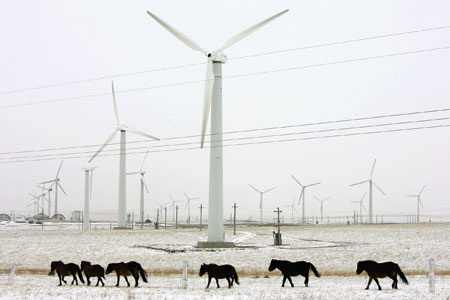
There is much more potential for cooperation than conflict between China and the United States on clean energy.

Yao Jian, spokesperson of the Ministry of Commerce of China, made those remarks on Tuesday in Beijing as a response to the U.S. trade investigation on China's clean energy policy.

"The U.S. has also made its policy on supporting its new energy industry to improve its competitiveness after the global financial crisis," said Yao.

He highlighted that China's clean energy policy is based on the country's strategy of shifting to a more eco-friendly economic growth model, which means a foundation for international cooperation, rather than confrontation.

He criticized those U.S. companies for ignoring their responsibility to protect the environment prompting the investigation for the purpose competition.
He also stressed that China's clean energy policy is in line with the WTO rules and international standards and the government would support Chinese enterprises and guilds to deal with those cases.

Before Yao's comments, Zhang Guobao, head of the National Energy Bureau of China, has also refused the U.S. criticism against China’s clean energy policy, pointing out that the United States has many more subsidies for its own clean energy industry.

The U.S. Trade Representative Office announced on Oct. 15 (local time) that upon the application from the United Steelworkers, it has initiated investigations under the 1301-1310 sections of the "1988 Omnibus Trade and Competition Law" into whether China's policies on clean energy constitute unfair subsidies for Chinese enterprises and at the same time discriminations against their foreign competitors.

An expo for green technology will be held in Beijing at the end of the month, the first of its kind in China. About 60 percent of the 212 enterprises to attend the expo are from foreign countries. As leaders of the sectors they are from, they will take this opportunity to show their products and technologies for energy efficiency, clean energy, environmental treatment and low carbon economy.

Yao hopes that the expo would be a platform where cooperation possibilities on clean energy technology can be exploited by Chinese and American enterprises.

By Li Jia, People's Daily Online


China Future Energy


China's Energy Future: The Middle Kingdom Seeks Its Place in the SunCooperation the the Energy Futures of China and the United StatesModelling China's Energy FutureChina's Energy Strategy: The Impact on Bejing's Maritime PoliciesEnergy consumption in China: past trends and future directions [An article from: Energy Economics]China's Past, China's Future (Asia's Transformations/Critical Asian Scholarship)
TG3CRZ2J3D2W

Brazil Ethanol Industry

Posted by Flora Sawita Labels: , , , , ,

Brazil has one of the largest renewable energy programs in the world, involving production of ethanol fuel from sugar cane, and ethanol now provides 18 percent of the country's automotive fuel. As a result of this, together with the exploitation of domestic deep water oil sources, Brazil, which years ago had to import a large share of the petroleum needed for domestic consumption, recently reached complete self-sufficiency in oil.

Brazil is promoting its brand of biofuels because the sugar-to-ethanol process releases a fraction of harmful greenhouse gases and requires only 1/5 of the gas and diesel it makes to produce ethanol from corn. Brazilian ethanol is also produced without official price props or government handouts offered in Europe and the US.

According to a recent article in the Wall Street Journal, Brazil is now producing ethanol for about $1.00/gallon compared with the international price of gasoline of about $1.50/gallon. In Brazil, ethanol is mostly derived from sugar cane, and is now available in 29,000 gas stations throughout the country, and represents about 20 percent of Brazil’s transport fuel market. Brazil’s use of traditional gasoline has actually declined since the late 1970’s.

One of the stimuli behind this move was the termination by the Brazilian government of support for the sugar industry, which forced sugar manufacturers to become more efficient and find other uses for the crop. According to the WSJ, 7 out of every 10 new cars sold in Brazil can use “flex-fuel”, meaning gasoline, ethanol, or a mixture of the two.

Brazil has become so efficient in ethanol production that it expects to double current exports of about $600 million/year to about $1.3 billion by 2010 (most sales are to Sweden and Japan). Ethanol releases less carbon dioxide than gasoline.

The Brazil ethanol model is being looked at by China, India, and the U.S. In the U.S., the most recent energy bill signed into law last August stipulates that the use of ethanol must double by 2012. But U.S. ethanol is made from corn which is about 30 percent more expensive than Brazil’s ethanol. According to WSJ, Henry Ford’s first car was made to run on ethanol.

Brazil’s improvement in ethanol efficiency has come in part due to biotechnology. Brazilian scientists at the Centro de Technologia Canaviera (funded by sugar growers), about 2 hours outside of Sao Paulo and in the heart of the sugar industry, have worked on decoding the DNA of sugar cane. The Center has helped Brazilian growers to select varieties of sugar cane that are more resistant to drought and pests, while at the same time yielding higher sugar content. The Center has developed some 140 new varieties of sugar cane over the last 20 years, which has helped lower the cost of growing sugar cane by about 1 percent/year. Brazilians used to get 2,000 liters (520 gallons) of ethanol out of a hectare (2.5 acres) of sugar cane. That yield has triple to about 6,000 liters/hectare.

Additionally satellite imagery of Brazilian sugar cane fields has helped Brazilian researchers to identify which variety of sugar cane will grow best in different parts of the country, the best time to harvest, and where to situate new fields.

Brazil Ethanol Companies


See: Brazillian Sugarcane Industry Association Website


 Ethanol Process
Process Synthesis for Fuel Ethanol Production (Biotechnology and Bioprocessing)The 2009-2014 World Outlook for Fuel Ethanol Manufactured by the Wet Mill ProcessEthanol Producer Magazine Cellulosic Ethanol: The Feedstock Factor Partnership Forms to Commercialize Rice-straw-to-ethanol Process Termites May Hold Key to Unlocking Cellulosic Bonds How Much Is a Ton of Biomass Worth (14) 
Jan Liao Hua Hsueh Hsueh Pao = Journal of Fuel Chemistry andFuel Oil NewsAdvanced Fuel Cell Technology 

US – Domestic fuel increase through 2030

Posted by Flora Sawita Labels: , , , ,


The US DOE’s Energy Information Administration predicts that American consumption of liquid fuel will increase by a mere one million barrels each day through to 2030 and that bio-fuels will provide enough supply to meet the demand, Ethanolproducer.com reports.

Increased use of domestically-produced bio-fuels will also contribute to an almost 10% decline in liquid fuels imports by 2030. According to the EIA’s 2009 Annual Energy Outlook, petroleum prices will continue to drive the rate at which renewable fuels are consumed. Overall oil consumption shows no growth between 2007 and 2030 as a result of increasing corporate average fuel economy (CAFE) standards and increased requirements for renewable fuels.

However one EIA model shows that if oil-producing countries rapidly expand their petroleum output to keep oil per barrel prices low, bio-fuel consumption might only reach 27 billion gallons by 2030. On the other end of the scale, the EIA’s high oil price model predicts that if oil producers maintain tight control over their supply and prices increase to near $200 per barrel in 2030, total bio-fuel consumption could reach 40 billion gallons.

In Oregon, Chemeketa Community College, Pacific Biodiesel Technologies and Wildwood have proposed a $10 million pilot-scale bio-fuels plant and training facility at Mill Creek Junction, near Salem, Biofuels Digest reports. The proposed project is co-located with the state’s largest commercial bio-diesel plant, Sequential-Pacific Biodiesel.

The facility would produce up to 432,000 gallons of bio-fuels and 660 kilowatts of power, and include training and R&D facilities, and would create up to 450 jobs within the state. The facility would work with agri-waste, algae and woody waste as feedstocks.

Snohomish County is going ahead with plans to get into the bio-diesel business, King 5 News reports. The county has plans to produce enough bio-diesel to eventually fuel its entire fleet of vehicles.

Just this weekend Seattle bio-diesel producers and consumers met to discuss the steady decline of the industry. International markets are forcing up the costs of materials to make bio-diesel at a time when oil and gas prices are going down.

Supporters of Snohomish County's plan say they can avoid those problems by keeping it local. A County Councilman told King 5 their plan would use canola grown by local farmers, heated in the County's own seed driers which would be fuelled by methane gas captured from an old landfill near Everett.

Investment experts and bio-fuel industry representatives are criticizing a $176-million, two-year California plan to reduce transportation greenhouse gas (GHG) emissions by subsidizing a range of alternative fuels and vehicles, claiming the initiative allocates a large chunk of money for unproven hydrogen and electric drive-train technologies, Carbon Control News reports.

These critics charge the plan undervalues many technologies that could significantly reduce transportation GHG emissions in the near-term, such as increasing the use of renewable and biomass-based fuels. California's plan to advance alternative fuels and vehicles -- including prioritizing which technologies to fund at $800 million over the next six years -- may serve as a model for other states and the federal government, as officials look to cut transportation GHGs, increase energy efficiency and reduce dependency on fossil fuels. Iowa energy officials have approved more than $2 million for an effort to grow algae at a southwest Iowa ethanol plant and use the material to make fuel, Fox News reports.

The 18-member Iowa Power Fund Board approved the grant this week to assist in the commercialization of algae production technology. (14 April 2009)

Canada- Funding for clean energy

Posted by Flora Sawita Labels: , ,

The Canadian Renewable Fuels Association has welcomed the Canadian government’s announcement of a new $1 Billion Clean Energy Fund and the $200 million set aside for demonstration projects of renewable and alternative energy technologies, Market Wire reports.

CRFA said that the $200 million set aside for smaller-scale demonstration projects of renewable and alternative energy technologies would help Canada take part in developing even better and more advanced renewable fuels. (May 21, 2009)

Label

2011 News AGRIBISNIS APINDO Africa Agriculture Business Agriculture Land Argentina Australia Bangladesh Berita Berita Detikcom Berita Info Jambi Berita Kompas Berita Padang Ekspres Berita Riau Pos Berita Riau Today Berita Tempo Berita riau terkini Biodiesel Bursa Malaysia CPO Tender Summary Cattle and Livestock China Cocoa Company Profile Corn Cotton Crude Palm Oil (CPO) and Palm Kernel Oil (PKO) Dairy Dairy Products Edible Oil Euorope European Union (EU) FDA and USDA Fertilizer Flood Food Inflation Food Security Fruit Futures Futures Cocoa and Coffee Futures Edible Oil Futures Soybeans Futures Wheat Grain HUKUM India Indonesia Info Sawit Investasi Invitation Jarak pagar Kakao Kapas Karet Kebun Sawit BUMN Kebun Sawit Swasta Kelapa sawit Kopi Law Lowongan Kerja MPOB Malaysia Meat News Nilam Oil Palm Oil Palm - Elaeis guineensis PENGUPAHAN PERDA Pakistan Palm Oil News Panduan Pabrik Kelapa Sawit Penawaran menarik Pesticide and Herbicide Poultry REGULASI RSPO Rice SAWIT Serba-serbi South America Tebu Technical Comment (CBOT Soyoil) Technical Comment (DJI) Technical Comment (FCPO) Technical Comment (FKLI) Technical Comment (KLSE) Technical Comment (NYMEX Crude) Technical Comment (SSE) Technical Comment (USD/MYR) Teknik Kimia Thailand Trader's Event Trader's highlight USA Ukraine Usaha benih Vietnam Wheat benih bermutu benih kakao benih kelapa benih palsu benih sawit benih sawit unggul bibit sawit unggul biofuel biogas budidaya sawit corporation palm oil pembelian benih sawit perburuhan pertanian soybean umum varietas unggul