RSS Feed
Tampilkan postingan dengan label Cassava. Tampilkan semua postingan

Cassava Plantation to revive Nigeria’s economy

Posted by Flora Sawita Labels: , , ,


Our cassava plan is to revive Nigeria’s economy – Adesina

By Jimoh Babatunde

(Vanguard) THE Minister of Agriculture, Dr. Akinwumi Adesina,  has revealed that the  Cassava Transformation Plan of his ministry is meant to revive the country’s economy and create jobs for millions of Nigerians.

Speaking during a meeting with partners from the bakery industry, the minister explained that Nigeria’s food import bill is exceptionally high; with the top four imports consuming over 1.3 trillion naira in foreign exchange every year.

“Our food imports are growing at an unsustainable rate of 11% per annum, fueling domestic inflation and driving poverty.  We are importing products that we can either produce in abundance, such as 356 billion naira worth of rice, 217 billion naira worth of sugar and 97 billion naira worth of fish; or are importing products that we can easily find local alternatives for us to reduce our import bill, such as 635 billion naira being spent on importing wheat. “

Dr. Adesina said that the import dependency is hurting Nigerian farmers, displacing local production and creating rising unemployment. “Our unemployment rate is spiraling, increasing from 12.7% in 2007 to 20.6% in 2010, driven by a wave of 4 Million young people entering the workforce every year, with only a small fraction able to find formal employment.

“As we examine the opportunities to sustainably reduce our food import bill, Cassava is a crop that provides tremendous potential.”

While noting that Cassava is an exceptionally important crop to the country, Adesina said as the world’s largest producer of Cassava with annual production currently at 40 million metric tons, the country is not a player on the global cassava market.

“So, while being the largest producer in the world, Nigeria accounts for zero percent of global trade in value added cassava products, while Thailand, which represents only 10% of the total production in the world, accounts for 80% of the global trade in cassava value added products.

“Cassava farmers in Nigeria face huge challenges, including lack of access to high yielding varieties, limited access to appropriate cassava processing technologies and highly volatile price swings for cassava due to poorly developed markets.”

Adesina added that the poor market development has caused the price of Cassava to plummet from 20,000 Naira per MT during the Presidential Initiative on Cassava to as low as 5,000 Naira per MT today.

Reaping in tears

“The price is so low many farmers have abandoned their fields, as the cost to harvest the Cassava is higher than the value they will receive for the Cassava. This creates a situation where farmers sow in hope and reap in tears.”

The only way the country can turn the situation around according to the minister is to create a new markets for Cassava. “Our Cassava Transformation Plan calls for a sharp focus on diversifying product and market opportunities for cassava for our farmers. We are working aggressively to create sustainable value chains for cassava and stabilize prices for farmers. Our major focus is on high quality cassava flour for use in composite flours to substitute for some of the wheat flour being imported.”

Dr. Adesina explained that the 40% cassava bread launched by President Jonathan recently from blending 40% High Quality Cassava Flour with 60% Wheat flour is a way out.

He added   “In his 2012 budget speech, Mr President backed this up with bold fiscal policies to promote the substitution of wheat flour with 40% high quality cassava flour in bread. Government has raised the tariff on imported wheat to encourage the substitution of wheat flour with high quality cassava flour.”

The Agriculture minister disclosed that  all equipment and machinery for processing high quality cassava flour and composite flours will attract zero taxes, “all flour mills, producers of high quality cassava flour who attain the 40% substitution with high quality cassava flour will receive a 12% tax rebate.

Cassava (Manihot esculenta)

Posted by Flora Sawita Labels:

Cassava-Manihot-esculenta
Agriculture | Cassava | Cassava also called yuca or manioc, is a tuberous, woody, shruby perennial plant, Manihot esculenta, of the Euphorbiaceae (spurge family), characterized by palmately lobed leaves, inconspicuous flowers, and a large, starchy, tuberous root with a tough, papery brown bark and white to yellow flesh.The name cassava (Manihot esculenta) also is used for this tuber, which is a major source of carbohydrates and is a dietary staple in many tropical nations. This plant and root also are known as yuca, manioc, and mandioca.

While native to South America, cassava (Manihot esculenta) now is extensively cultivated as an annual crop in many tropical and subtropical regions of the world, including Africa, India, and Indonesia, with Africa its largest center of production.This is a prolific crop that can grow in poor soil and is drought tolerant. It is the one of the most important food plants in the tropics and the third largest source of carbohydrates for human food in the world.

The roots and leaves contain cyanogenic glucosides, which offer a protection against some herbivores, but also make the plant toxic to humans if consumed without prior treatment, such as leaching and drying. In particular, the varieties known as "bitter cassava" contain significant amounts of cyanide, with the "sweet cassava" less toxic. It is a unique aspect of human beings to be able to process toxic plants into a form that makes them edible.

Cassava (Manihot esculenta) is the source of flour called tapioca, as well as is used for breads, and alcoholic beverages. The leaves also can be treated and eaten. However, cassava is a poor source of protein and reliance on cassava (Manihot esculenta) as a staple food is associated with the disease kwashiorkor.

Manihot esculenta, or cassava, is a slightly woody, generally shruby plant that typically grows from one to three meters (3-10 feet) in height (Katz and Weaver 2003). The leaves are nearly palmate (fan- or hand-shaped) and dark green in color. There are over 5,000 varieties of cassava known, each with distinct qualities, and they range from low herbs to shrubs with many branches, to unbranched trees.

The cassava (Manihot esculenta) root is long and tapered, with a firm homogeneous flesh encased in a detachable rind, about 1 millimeter thick, and rough and brown on the outside, just like a potato. Commercial varieties can be 5 to 10 centimeters in diameter at the top, and 50 to 80 centimeters long. A woody cordon runs along the root's axis. The flesh can be chalk-white or yellowish.

Although there are many varieties of cassava, there are two main varieties, sweet and bitter. These are classified on the basis of how toxic are the levels of cyanogenic glucosides.

The Cassava (Manihot esculenta) plant gives the highest yield of food energy per cultivated area per day among crop plants, except possibly for sugarcane. - CASSAVA - AGRICULTURE

Simple Cassava Slicing Machine

Posted by Flora Sawita Labels: , , ,

Simple Cassava Slicing Machine-1
Simple Cassava Slicing Machine - Slicing cassava for the production of cassava chips or other products is mostly done in the rural community. For slicing cassava in large quantities can be made easier and accelerated with the help of simple cassava slicing machine.

Slicing cassava can be done with cassava slicing machine with manual propulsion or by hand. The result is much more and more delicate. The use of electric cassava slicing machine can be faster, not laborious and the yields are even more.

1. Function:
To slice peeled cassava to a desired thicknes so can be processed or fried into chips.

2. Instruction:
1. Prepare raw materials which will be sliced
2. Sharpen slicer's blade and clean before use
3. Adjust the position of the blade to make desired thickness of sliced cassava
4. Turned on the machine.
5. Place raw materials on the slicer blade while driven slowly, so that all the materials chopped.
6. When all is done, clean all part of the tools.

3. Specifications:
1. Dimensions: L = 47 cm W = 45 cm; H = 80 cm
2. Weight: 10 kg
3. Propulsion: Electric Motor 1.0 hp
4. Capacity: 50 kg / hr
5. Operator: 1 person
6. Materials: steel plate, angle steel, aluminum

4. Contact - Manufactutrer:
Project Section of Appropriate Technology, Appropriate Technology Development Center, LIPI; Jl. KS. Tubun No. 5 Subang; Tel. / Fax. (0260) 417348, 411 478 Jakarta

Source:
Rural Technology Machinery Product Specifications, Project Section of Appropriate Technology, Appropriate Technology Development Center, LIPI

How to Make Cassava Flour

Posted by Flora Sawita Labels: , , , ,

Cassava flour is made from cassava pieces that have been dried, then crushed. For producing good cassava flour, cassava that used must be good and old enough. Cassava that harvested after 6 months cultivation have still very high water so that the flour substance is only a little. Cassava flour is commonly used as ingredient to make many kind of foods.

Raw Materials:
  • Manihot (cassava)

Equipments:
  • Knife
  • Bowl or pan
  • Chopper (cutting board)
  • Winnowing
  • Sieve
  • Pestle (mortar and pestle)

    Directions:
    1. Peel the cassava, wash and dry in the sun
    2. Put dried cassava into mortar, and then mashed
    3. Then sifter with a fine sieve
    4. Mash the rest of the sifting once again, and sifter back until smooth
    5. Dry the flour in the sun. If rain, the drying is done in a room with artificial heating, such as using stoves or oven.

    Flow Diagram of Cassava Flour Processing 


    By: HarryS

    About Starch

    Posted by Flora Sawita Labels: , , , , , , ,

    Starch or amylum is a carbohydrate consisting of a large number of glucose units joined together by glycosidic bonds. This polysaccharideis produced by all green plants as an energy store. It is the most important carbohydrate in the human diet and is contained in such staple foods as potatoes, wheat, maize (corn), rice, and cassava.

    Pure starch is a white, tasteless and odorless powder that is insoluble in cold water or alcohol. It consists of two types of molecules: the linear and helical amylose and the branched amylopectin. Depending on the plant, starch generally contains 20 to 25% amylose and 75 to 80% amylopectin. Glycogen, the glucose store of animals, is a more branched version of amylopectin.

    Starch is processed to produce many of the sugars in processed foods. When dissolved in warm water, it can be used as a thickening, stiffening or gluing agent, giving wheatpaste.

    Name

    The word "starch" is derived from Middle English sterchen, meaning to stiffen. "Amylum" is Latin for starch, from the Greek "amulon" which means "not ground at a mill". The root amyl is used in biochemistry for several compounds related to starch.

    History

    Structure of the amylose molecule
    Wheat starch paste was used by Egyptians to stiffen cloth and during weaving linen and possibly to glue papyrus. Romans used it also in cosmetic creams, to powder the hair and to thicken sauces. Persians and Indians used it to make dishes similar to gothumai wheat halva. In China, with the invention of paper, rice starch was used as a surface treatment of the paper.
    In photosynthesis, plants use light energy to produce glucose from carbon dioxide. The glucose is stored mainly in the form of starch granules, in plastids such as chloroplasts and especially amyloplasts. Toward the end of the growing season, starch accumulates in twigs of trees near the buds. Fruit, seeds, rhizomes, and tubers store starch to prepare for the next growing season.

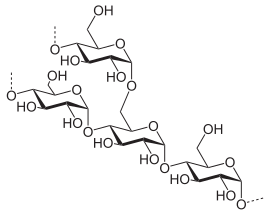
    Structure of the amylopectin molecule
    Glucose is soluble in water, hydrophilic, binds much water and then takes up much space; glucose in the form of starch, on the other hand, is not soluble and can be stored much more compactly.

    Glucose molecules are bound in starch by the easily hydrolyzed alpha bonds. The same type of bond can also be seen in the animal reserve polysaccharide glycogen. This is in contrast to many structural polysaccharides such as chitin, cellulose and peptidoglycan, which are bound by beta-bonds and are much more resistant to hydrolysis.

    Biosynthesis

    Granules of wheat starch, stained
    with iodine, photographed through
    a light microscope.
    Plants produce starch by first converting glucose 1-phosphate to ADP-glucose using the enzyme glucose-1-phosphate adenylyltransferase. This step requires energy in the form of ATP. The enzyme starch synthase then adds the ADP-glucose via a 1,4-alpha glycosidic bond to a growing chain of glucose residues, liberating ADP and creating amylose. Starch branching enzymeintroduces 1,6-alpha glycosidic bonds between these chains, creating the branched amylopectin. The starch debranching enzyme isoamylaseremoves some of these branches. Several isoforms of these enzymes exist, leading to a highly complex synthesis process. While amylose was traditionally thought to be completely unbranched, it is now known that some of its molecules contain a few branch points.
    Glycogen and amylopectin have the same structure, but the former has about one branch point per ten 1,4-alpha bonds, compared to about one branch point per thirty 1,4-alpha bonds in amylopectin. Another difference is that glycogen is synthesised from UDP-glucose while starch is synthesised from ADP-glucose.

    Properties

    Structure

    Starch molecules arrange themselves in the plant in semi-crystalline granules. Each plant species has a unique starch granular size: rice starch is relatively small (about 2μm) while potato starches have larger granules (up to 100μm). Although in absolute mass only about one quarter of the starch granules in plants consist of amylose, there are about 150 times more amylose molecules than amylopectin molecules. Amylose is a much smaller molecule than amylopectin.

    Starch becomes soluble in water when heated. The granules swell and burst, the semi-crystalline structure is lost and the smaller amylose molecules start leaching out of the granule, forming a network that holds water and increasing the mixture's viscosity. This process is calledstarch gelatinization. During cooking the starch becomes a paste and increases further in viscosity. During cooling or prolonged storage of the paste, the semi-crystalline structure partially recovers and the starch paste thickens, expelling water. This is mainly caused by the retrogradation of the amylose. This process is responsible for the hardening of bread orstaling, and for the water layer on top of a starch gel (syneresis).

    Some cultivated plant varieties have pure amylopectin starch without amylose, known as waxy starches. The most used is waxy maize, others are glutinous rice and waxy potato starch. Waxy starches have less retrogradation, resulting in a more stable paste. High amylose starch, amylomaize, is cultivated for the use of its gel strength.

    Hydrolysis

    The enzymes that break down or hydrolyze starch into the constituent sugars are known as amylases.

    Alpha-amylases are found in plants and in animals. Human saliva is rich in amylase, and the pancreas also secretes the enzyme. Individuals from populations with a high-starch diet tend to have more amylase genes than those with low-starch diets; chimpanzees have very few amylase genes. It is possible that turning to a high-starch diet was a significant event in human evolution.

    Beta-amylase cuts starch into maltose units. This process is important in the digestion of starch and is also used in brewing, where the amylase from the skin of the seed grains is responsible for converting starch to maltose (Malting, Mashing).

    Dextrinization

    If starch is subjected to dry heat, it breaks down to form pyrodextrins, in a process known as dextrinization. Pyrodextrins are brown in color. This process is partially responsible for the browning of toasted bread.

    Chemical Tests

    Starch, 800x magnified, under polarized light
    Iodine solution is used to test for starch; a dark blue color indicates the presence of starch. The details of this reaction are not yet fully known, but it is thought that the iodine (I3-and I5-ions) fit inside the coils of amylose, the charge transfers between the iodine and the starch, and the energy level spacings in the resulting complex correspond to the absorption spectrum in the visible light region. The strength of the resulting blue color depends on the amount of amylose present. Waxy starches with little or no amylose present will color red.

    Starch indicator solution consisting of water, starch and iodine is often used in redox titrations: in the presence of an oxidizing agent the solution turns blue, in the presence of reducing agent the blue color disappears because triiodide (I3-) ions break up into three iodide ions, disassembling the starch-iodine complex. A 0.3% w/w solution is the standard concentration for a starch indicator. It is made by adding 3 grams of soluble starch to 1 litre of heated water; the solution is cooled before use (starch-iodine complex becomes unstable at temperatures above 35 °C).

    Microscopy of starch granules - Each species of plant has a unique shape of starch granules in granular size, shape and crystallisation pattern. Under the microscope, starch grains stained with iodine illuminated from behind with polarized light show a distinctive Maltese cross effect (also known as extinction cross and birefringence).

    Starch as Food

    Starch is the most important carbohydrate in the human diet and is contained in many staple foods. The major sources of starch intake worldwide are rice, wheat, maize (corn), potatoes and cassava. Widely used prepared foods containing starch are bread, pancakes, cereals, noodles, pasta, porridge and tortilla.

    Depending on the local climate other starch sources are used for food, suchas acorn,arrowroot, arracacha, banana, barley, breadfruit, buckwheat, canna, colacasia, katakuri, kudzu, malanga, millet, oat, oca, polynesian arrowroot, sago, sorghum, sweet potato, rye, taro, water chestnut and yams. Chestnuts and edible beans, such as favas, lentils, mung bean and peas, are also rich instarch.

    Digestive enzymes have problems digesting crystalline structures. Raw starch will digest poorly in the duodenum and small intestine, while bacterial degradation will take place mainly in the colon. Resistant starch is starch that escapes digestion in the small intestine of healthy individuals. In order to increase the digestibility, starch is cooked. Hence, before humans started using fire, eating grains was not a very useful way to get energy.

    Starch Industry

    The starch industry extracts and refines starches from seeds, roots and tubers, by wet grinding, washing, sieving and drying. Today, the main commercial refined starches arecornstarch, tapioca, wheat and potato starch. To a lesser extent, sources include rice, sweet potato, sago and mung bean. Historically, Florida arrowroot was also commercialized. Starch is still extracted from more than 50 types of plants.

    Untreated starch requires heat to thicken or gelatinize. When a starch is pre-cooked, it can then be used to thicken instantly in cold water. This is referred to as a pregelatinized starch.

    Starch Sugars

    Starch can be hydrolyzed into simpler carbohydrates by acids, various enzymes, or a combination of the two. The resulting fragments are known as dextrins. The extent of conversion is typically quantified by dextrose equivalent (DE), which is roughly the fraction of the glycosidic bonds in starch that have been broken.

    These starch sugars are by far the most common starch based food ingredient and are used as sweetener in many drinks and foods. They include:
    • Maltodextrin, a lightly hydrolyzed (DE 10-20) starch product used as a bland-tasting filler and thickener.
    • Various glucose syrup / corn syrups (DE 30-70), viscous solutions used as sweeteners and thickeners in many kinds of processed foods.
    • Dextrose (DE 100), commercial glucose, prepared by the complete hydrolysis of starch.
    • High fructose syrup, made by treating dextrose solutions with the enzyme glucose isomerase, until a substantial fraction of the glucose has been converted to fructose. In the United States, high fructose corn syrup is the principal sweetener used in sweetened beverages because fructose has better handling characteristics, such as microbiological stability, and more consistent sweetness/flavor. High fructose corn syrup has the same sweetness as sugar.
    • Sugar alcohols, such as maltitol, erythritol, sorbitol, mannitol and hydrogenated starch hydrolysate, are sweeteners made by reducing sugars.

    Modified Starches

    A modified food starch is a starch that has been chemically modified to allow the starch to function properly under conditions frequently encountered during processing or storage, such as high heat, high shear, low pH, freeze/thaw and cooling.

    The modified starches are E coded according to the International Numbering System for Food Additives (INS):
    • 1401 Acid-treated starch
    • 1402 Alkaline-treated starch
    • 1403 Bleached starch
    • 1404 Oxidized starch
    • 1405 Starches, enzyme-treated
    • 1410 Monostarch phosphate
    • 1412 Distarch phosphate
    • 1413 Phosphated distarch phosphate
    • 1414 Acetylated distarch phosphate
    • 1420 Starch acetate
    • 1422 Acetylated distarch adipate
    • 1440 Hydroxypropyl starch
    • 1442 Hydroxypropyl distarch phosphate
    • 1443 Hydroxypropyl distarch glycerol
    • 1450 Starch sodium octenyl succinate
    • 1451 Acetylated oxidized starch

    INS 1401, 1402, 1403 and 1405 are in the EU food ingredients without an E-number. Typical modified starches for technical applications are cationic starches, hydroxyethyl starch and carboxymethylated starches.

    Use as Food Additive 

    As an additive for food processing, food starches are typically used as thickeners and stabilizers in foods such as puddings, custards, soups, sauces, gravies, pie fillings, and salad dressings, and to make noodles and pastas.

    Gummed sweets such as jelly beans and wine gums are not manufactured using a mold in the conventional sense. A tray is filled with native starch and leveled. A positive mold is then pressed into the starch leaving an impression of 1000 or so jelly beans. The jelly mix is then poured into the impressions and put into a stove to set. This method greatly reduces the number of molds that must be manufactured.
    In the pharmaceutical industry, starch is also used as an excipient, as tablet disintegrant or as binder.

    Industrial Application 

    Papermaking is the largest non-food application for starches globally, consuming millions of metric tons annually. In a typical sheet of copy paper for instance, the starch content may be as high as 8%. Both chemically modified and unmodified starches are used in papermaking. In the wet part of the papermaking process, generally called the “wet-end”, the starches used are cationic and have a positive charge bound to the starch polymer. These starch derivatives associate with the anionic or negatively charged paper fibers /cellulose and inorganic fillers. Cationic starches together with other retention and internal sizing agent help to give the necessary strength properties to the paper web to be formed in the papermaking process (wet strength), and to provide strength to the final paper sheet (dry strength).

    Starch adhesive.
    In the dry end of the papermaking process the paper web is rewetted with a starch based solution. The process is called surface sizing. Starches used have been chemically, or enzymatically depolymerized at the paper mill or by the starch industry (oxidized starch). The size - starch solutions are applied to the paper web by means of various mechanical presses (size press). Together with surface sizing agent the surface starches impart additional strength to the paper web and additionally provide water hold out or “size” for superior printing properties. Starch is also used in paper coating as one of the binders for the coating formulation a mixture of pigments, binders and thickeners. Coated paper has improved smoothness, hardness, whiteness and gloss and thus improves printing characteristics.

    Corrugated board adhesives are the next largest application of non-food starches globally. Starch glues are mostly based on unmodified native starches, plus some additive such asborax and caustic soda. Part of the starch is gelatinized to carry the slurry of uncooked starches and prevent sedimentation. This opaque glue is called a SteinHall adhesive. The glue is applied on tips of the fluting. The fluted paper is pressed to paper called liner. This is then dried under high heat, which causes the rest of the uncooked starch in glue to swell/gelatinize. This gelatinizing makes the glue a fast and strong adhesive for corrugated board production.

    Another large non-food starch application is in the construction industry, where starch is used in the gypsum wall board manufacturing process. Chemically modified or unmodified starches are added to the stucco containing primarily gypsum. Top and bottom heavyweight sheets of paper are applied to the formulation, and the process is allowed to heat and cure to form the eventual rigid wall board. The starches act as a glue for the cured gypsum rock with the paper covering, and also provide rigidity to the board.

    Starch is used in the manufacture of various adhesives or glues for book-binding, wallpaper adhesives, paper sack production, tube winding, gummed paper, envelop adhesives, school glues and bottle labeling.

    Starch derivatives, such as yellow dextrins, can be modified by addition of some chemicals to form a hard glue for paper work; some of those forms use borax or soda ash, which are mixed with the starch solution at 50-70 °C to create a very good adhesive. Sodium silicate can be added to reinforce these formulae.

    Clothing starch or laundry starch is a liquid that is prepared by mixing a vegetable starch in water (earlier preparations also had to be boiled), and is used in the laundering of clothes. Starch was widely used in Europe in the 16th and 17th centuries to stiffen the wide collars and ruffs of fine linen which surrounded the necks of the well-to-do. During the 19th century and early 20th century, it was stylish to stiffen the collars and sleeves of men's shirts and the ruffles of girls' petticoats by applying starch to them as the clean clothes were being ironed. Aside from the smooth, crisp edges it gave to clothing, it served practical purposes as well. Dirt and sweat from a person's neck and wrists would stick to the starch rather than to the fibers of the clothing, and would easily wash away along with the starch.

    After each laundering, the starch would be reapplied. Today, the product is sold in aerosol cans for home use.


    Starch is also used to make some packing peanuts, and some drop ceiling tiles.

    Textile chemicals from starch are used to reduce breaking of yarns during weaving; the warp yarns are sized, especially for cotton. Starch is also used as textile printing thickener.

    In the printing industry, food grade starch is used in the manufacture of anti-set-off spray powder used to separate printed sheets of paper to avoid wet ink being set off.

    Starch is used to produce various bioplastics, synthetic polymers that are biodegradable. An example is polylactic acid.

    For body powder, powdered corn starch is used as a substitute for talcum powder, and similarly in other health and beauty products.

    In oil exploration, starch is used to adjust the viscosity of drilling fluid, which is used to lubricate the drill head and suspend the grinding residue in petroleum extraction.

    Glucose from starch can be further fermented to biofuel ethanol.

    Hydrogen production can use starch as the raw material, using enzymes.


    References
    1. ^ Brown, W. H.; Poon, T. (2005). Introduction to organic chemistry (3rd ed.). Wiley. ISBN0-471-44451-0. .
    2. ^ Revedin A, Aranguren B, Becattini R, Longo L, Marconi E, Lippi MM, Skakun N, Sinitsyn A, Spiridonova E, Svoboda J. (2010). "Thirty thousand-year-old evidence of plant food processing". Proc Natl Acad Sci U S A. 107: 18815–18819. doi:10.1073/pnas.1006993107. PMID 20956317.
    3. ^ Pliny the Elder, The Natural History (Pliny), Book XIII, Chapter 26, The paste used in preparation of paper
    4. ^ Smith, A M (2001). "The biosynthesis of starch granules". Biomacromolecules 2 (2): 335–41. doi:10.1021/bm000133c. PMID 11749190.
    5. ^ David R. Lineback, "Starch", in AccessScience@McGraw-Hill.
    6. ^ Stryer, Lubert; Berg, Jeremy Mark; Tymoczko, John L. (2002). "Section 11.2.2". Biochemistry (5th ed.). San Francisco: W.H. Freeman. ISBN 0-7167-3051-0. http://www.ncbi.nlm.nih.gov/books/bv.fcgi?rid=stryer.section.1517#1522.
    7. ^ a b "Diet and the evolution of human amylase gene copy number variation". Nature Genetics by Nature Publishing Group. http://www.nature.com/ng/journal/v39/n10/full/ng2123.html.
    8. ^ PZ Myers, Amylase and human evolution, December 11, 2008.
    9. ^ Anne-Charlotte Eliasson (2004). Starch in food: Structure, function and applications. Woodhead Publishing. ISBN 9780849325557.
    10. ^ http://www.elmhurst.edu/~chm/vchembook/549sweet.html
    11. ^ http://www.foodproductdesign.com/articles/2008/12/hfcs-how-sweet-it-is.aspx
    12. ^ Modified Starches. CODEX ALIMENTARIUS published in FNP 52 Add 9 (2001)
    13. ^ "Starch based glue". - ICI. http://www.nationalstarch.com/NationalStarch/About+Us/Our+Businesses.
    14. ^ "Spray Powder". Russell-Webb. Archived from the original on 2007-08-09. http://web.archive.org/web/20070809214841/http://www.russell-webb.com/anti_set_off_powder/soluble_anti-set-off-powder.html. Retrieved 2007-07-05.
    15. ^ Zhang YH, Evans BR, Mielenz JR, Hopkins RC, Adams MW (2007). "High-yield hydrogen production from starch and water by a synthetic enzymatic pathway". PLoS ONE 2 (5): e456. doi:10.1371/journal.pone.0000456. PMID 17520015. PMC 1866174. http://www.plosone.org/article/fetchArticle.action?articleURI=info:doi/10.1371/journal.pone.0000456.

     Retrieved from: Wikipedia

    Trenggalek : Make Cassava Flour as Its Agriculture Main Product

    Posted by Flora Sawita Labels: , , , ,

    MOCAF (Modified Cassava Flour) as an alternative to wheat material has a big potential to be developed in Trenggalek. Minister of Agriculture Suswono, on Tuesday (24/11) last year, was launched Cassava Flour Production Acceleration or cassava flour and the National Declaration in Countryside / Sub Authorship, Trenggalek District, East Java. Representatives of farmers from 18 provinces participated in these activities. Proclamation of Independence was celebrated with National Flour-making contest Cassava flour confectionery raw materials.


    The declaration was attended by Director General PPHP and scope of the Department of Agriculture officials, Head of Department of Agriculture Crops and Hortikulutura East Java Province, the Head of the Agricultural Service accepting Agroindustrial development activities along with farmer group union starchy and starchy businessmen, and representatives of the IPB, UNEJ, and quality standard.

    DG PPHP (Processing and Marketing of Agricultural Products), Department of RI, Zaenal Bachrudin, in its report said that efforts to improve the image of cassava flour is expected to continue to do so that later became "Local Flour To me". One such effort is by declaration of acceleration of Fermented Cassava Flour Production and the Declaration of National Starch, as an effort to increase compliance preparation of flour by 20% over the next five years.

    DG PPHP, adding that in order to meet the consumption needs of starchy (as a source of starch and energy) at the moment still have to import 5,295,859 tons of wheat (2008). Therefore, to pursue domestic production of flour if necessary to increase the capacity of factories and the increase in the amount of flour processing units in the society especially in rural areas as the center for cassava production

    Regent Trenggalek, H. Soeharto, in his speech said that the cassava agro-industry is one of the driving in Trenggalek town, this is due to the huge potential of the planting areas and involve the majority of the people of Trenggalek, in addition to cassava flour can be used as substitute for wheat flour. Regent added that at this time in order to increase food security so as not to depend on rice, the Government Trenggalek continue to increase the diversity of food, which had been invited to West Java to the proposal Puspitek Mocaf (Modified cassava Floor).

    "This event is to demonstrate to farmers of cassava, that Trenggalek, even to the Central Government is concerned with the development of Mocaf Flour production," according to among others, submitted H. Suharto during the opening ceremony last year.

    According to Minister of Agriculture Suswono, people tend to be interested in practical food products in penyajiaannya, and seem more modern, such products as noodles, bread, snacks, baby foods and so forth. Changes in food consumption pattern (food habits), this causes the need for food-based starchy increased rapidly, one of the greatest consumption is wheat flour.

    The evaluation results show MOCAF can be used as a food ingredient with a very wide usage. MOCAF turned out to not only be used as supplementary materials, but can be directly used as raw materials from a variety of foods, ranging from noodles, bakery, cookies until semi-moist food. With little change in the formula, or process, because this product is not exactly the same characteristics with wheat flour, rice or other, can produce optimum quality products.

    Brownish cake, steamed cake and spongy cake can be made with 100% raw material MOCAF as flour. Product produced has the characteristic that is not much different from the products made using low protein flour types (soft wheat). As product development based on the volume of beaten egg, then it is not difficult for MOCAF to replace the wheat flour.

    Furthermore, the Indonesian Government will pursue the elimination of import of wheat flour for industrial materials. Minister of Agriculture said it would try to reduce it Suswono gradually. Dependence of grain amounted to 20 percent or 5.2 million tons in 2008 and is expected to increase 5.6 million tons in 2009, will be replaced by increasing production of cassava flour.

    According to him, the solution is impossible given the production of manioc (cassava) nationally reached 22.7 million tons / year. As of that amount, a total of 22.31 percent has been processed into food or nonpangan. "This is an opportunity for us to make food self-sufficiency. So we do not depend anymore with imports," he said.

    In the meantime, the local government through the Department of Agriculture Trenggalek's been four years working as closely as possible to increase production Mocaf, as submitted by the Head of Department of Agriculture, Forestry and Plantation of Trenggalek, Ir. Surya Atmadja Wisnubroto. This is certainly very easy because of the supply side, the raw material of flour MOCAF cassava, one of the food crops that have traditionally been developed and have long been a staple food in Trenggalek, also has enormous potential.

    Request More From Production

    Some time earlier, when reviewing Cassava flour manufacturer, Surya explained by this increased demand was not matched by adequate availability of raw materials. Type of flour that had been circulating in the market are mostly made from raw wheat. In fact, wheat is a type of sub-tropical plants, are not very relevant to the climate and geographical conditions in Indonesia. Although it is often attempted, but until now there has been no effort to expand the cultivation of wheat economically.

    "Well, then, Cassava as raw material products from cassava, would be easily developed. Moreover, the quality is not inferior to Mocaf flour-both in terms of taste, nutritional and hygienic values," said Surya pointing Cassava-making process at the Village at the factory owned Kerjo risen Cassava Mandiri (BCM) Cassava producers. Integrated manufacturer with offices located right in the center Kerjo Village, District of Authorship, Trenggalek. From the office of Business Multipurpose Cooperative "Gemah Ripah Loh Jinawi" only separated a crowded soccer field is used when the evening arrived residents.

    At the edge of the road, in front of the factory, it appears some of the loaded truck was parked. That truck is the center of the cluster queue to be paid to the factory. In the courtyard own factories, a truck was parked. Some factory workers deftly unloaded from the truck, weighed and then shouldering the sacks containing the chip toward the barn.

    "We are very much assisted by the existence of this plant, Mas", said one of the employees Katno. According to existing employees, the plant has dozens of clusters that are spread in almost all Trenggalek.

    A man came closer, it is Cahyo Handriadi, one of the initiators of flour Mocaf who currently serves as manager of PT BCM . He told me that the business meal is a commodity they do Mocaf that very potential.

    Apart from the abundant raw materials, markets for these products was wide open. Potential of cassava are spread in almost all districts in the region Trenggalek. While market demand, particularly food companies, large enough.

    "Market Mocaf able to accommodate more than one thousand tons of production per month Mocaf. However, when this new PT BCM is able to produce 100 tonnes per month Mocaf." Cahyo said. With financial conditions already quite stable as it is today, actually PT BCM no longer face the problem of payment to the cluster. Problems arise precisely because the production capacity of the cluster has not been as expected. So that the grinding machine production capacity of 400 tonnes per month has not yet been optimized.

    Ir. Surya Atmadja Wisnubroto promised to seek various forms of maximum convenience for Mocaf smooth production. "During all in accordance with government regulations will serve the citizens desire. Moreover, in order to increase production and reduce unemployment, which ends would increase the PAD (Regional Original Income) ", he said. Increasing production any efforts currently intensively conducted by the Cooperative through increased production capacity of the cluster and the formation of new clusters." Approximately (necessary) 120 clusters to be able to meet the target of 400 tonnes, "said Cahyo. That's the target that was announced in this year.

    Retrieved from : Trenggalek Jelita

    The First Mocaf in the World

    Posted by Flora Sawita Labels: , ,

    The First Mocaf in the World | agriculture commodities | Indonesia breaks the world record again thanks to the invention of Dr Achmad Subagio, a researcher of the Faculty of Agricultural Technology, Jember University, who successfully invented mocaf, the latest processed product made from cassava Manihot esculenta.

    This invention is not a trivial thing since mocaf is able to substitute wheat flour on account of its aroma and taste which are equal to wheat flour. To make 1 kilo of noodles, as an example, mocaf 50 % substitute wheat flour. Meanwhile, to make cookies, the wheat flour may be completely substituted with mocaf.

    Mocaf is of great value as it is expected to reduce the demand for wheat flour which is still relying on import. As statistic shown, Indonesian wheat flour demand, in total, reaches 6-million tonnes per year. Thus, it is understandable that as we found mocaf, we can decrease foreign exchange current to abroad.

    Early this year, your reporter was invited to attend World Tapioca Conference in Bangkok. The world's cassava experts gathered there to discuss about big opportunity in developing the world's cassava but none of the experts mentioned cassava can be made into mocaf. Whereas, the value of mocaf is equal to dextrin, or other by-products made from cassava starch.

    Respective readers, mocaf is chosen as the main topic as to describe the most current up-to-date business opportunity. Accompanying mocaf, we present stories of how beautiful Haworthia truncata, gasteria or the rare aloe are. Meanwhile, for traditional medicinal plant observers, at the same time with the issuance of this magazine, we also publish Infokit Volume 08, which specially discussed Indonesian herbals complete with scientific evidences and ways to blend herbal ingredients, along with various healthy ways of life through traditional beverages. Enjoy reading! [ agriculture commodities ]

    Label

    2011 News AGRIBISNIS APINDO Africa Agriculture Business Agriculture Land Argentina Australia Bangladesh Berita Berita Detikcom Berita Info Jambi Berita Kompas Berita Padang Ekspres Berita Riau Pos Berita Riau Today Berita Tempo Berita riau terkini Biodiesel Bursa Malaysia CPO Tender Summary Cattle and Livestock China Cocoa Company Profile Corn Cotton Crude Palm Oil (CPO) and Palm Kernel Oil (PKO) Dairy Dairy Products Edible Oil Euorope European Union (EU) FDA and USDA Fertilizer Flood Food Inflation Food Security Fruit Futures Futures Cocoa and Coffee Futures Edible Oil Futures Soybeans Futures Wheat Grain HUKUM India Indonesia Info Sawit Investasi Invitation Jarak pagar Kakao Kapas Karet Kebun Sawit BUMN Kebun Sawit Swasta Kelapa sawit Kopi Law Lowongan Kerja MPOB Malaysia Meat News Nilam Oil Palm Oil Palm - Elaeis guineensis PENGUPAHAN PERDA Pakistan Palm Oil News Panduan Pabrik Kelapa Sawit Penawaran menarik Pesticide and Herbicide Poultry REGULASI RSPO Rice SAWIT Serba-serbi South America Tebu Technical Comment (CBOT Soyoil) Technical Comment (DJI) Technical Comment (FCPO) Technical Comment (FKLI) Technical Comment (KLSE) Technical Comment (NYMEX Crude) Technical Comment (SSE) Technical Comment (USD/MYR) Teknik Kimia Thailand Trader's Event Trader's highlight USA Ukraine Usaha benih Vietnam Wheat benih bermutu benih kakao benih kelapa benih palsu benih sawit benih sawit unggul bibit sawit unggul biofuel biogas budidaya sawit corporation palm oil pembelian benih sawit perburuhan pertanian soybean umum varietas unggul